BEECN Volunteers: Difference between revisions
| Line 18: | Line 18: | ||
| style="background:#e9ae97; text-align: center; border:2px solid white;"|'''<big>[[Main_Page#SECTION 800: Basic Earthquake Emergency Communication_Nodes (BEECN)|Back to Main Guidelines ↱]]</big>''' | | style="background:#e9ae97; text-align: center; border:2px solid white;"|'''<big>[[Main_Page#SECTION 800: Basic Earthquake Emergency Communication_Nodes (BEECN)|Back to Main Guidelines ↱]]</big>''' | ||
|} | |} | ||
This section covers the role, structure, and responsibilities of BEECN volunteers. Volunteers operate in organized cohorts, perform regular equipment checks, participate in drills, and deploy communication nodes 24–48 hours after a major earthquake. | This section covers the role, structure, and responsibilities of BEECN volunteers. Volunteers operate in organized cohorts, perform regular equipment checks, participate in drills, and deploy communication nodes 24–48 hours after a major earthquake. A NET volunteer can also volunteer for BEECN. | ||
{| class="wikitable" | {| class="wikitable" | ||
|+ | |+ | ||
| Line 77: | Line 77: | ||
PBEM will provide training to designated BEECN volunteers instructing on the deployment and use of BEECN equipment on an as-needed basis. PBEM encourages members of a BEECN Cohort to teach each other in the use of equipment when possible. | PBEM will provide training to designated BEECN volunteers instructing on the deployment and use of BEECN equipment on an as-needed basis. PBEM encourages members of a BEECN Cohort to teach each other in the use of equipment when possible. | ||
=== BEECN Volunteer | === BEECN Volunteer Teams === | ||
# Each BEECN should have a | # Each BEECN should have a team of no fewer than eight volunteers who are trained and familiar with the BEECN cache. | ||
# One of the eight in a | # One of the eight in a team will be the Coordinator for that BEECN team. The responsibilities of the Coordinator are described in the section titled BEECN Team Coordinators and reflected in the [[VSF 14.01.02: BEECN Coordinator|volunteer position description]]. | ||
# A | # A team is divided into two shifts (Shift A and Shift B) of four volunteers each. The intention is that in an emergency deployment, each shift will work for eight hours maximum and relay to the other shift at the end of eight hours. See [[Operations at BEECN Sites#BEECN Operational Periods and shifts|Operational Periods and Shifts]]. | ||
# Shift A and Shift B are further divided between two Primary Volunteers and two Backup Volunteers. If a Primary Volunteer is injured or for some other reason cannot deploy the BEECN, Backup Volunteers are available to fill in or take over deployment responsibilities. See ''[[Media:BEECN Volunteer Shifts.png|Figure 1: BEECN Cohort Organization]].'' | # Shift A and Shift B are further divided between two Primary Volunteers and two Backup Volunteers. If a Primary Volunteer is injured or for some other reason cannot deploy the BEECN, Backup Volunteers are available to fill in or take over deployment responsibilities. See ''[[Media:BEECN Volunteer Shifts.png|Figure 1: BEECN Cohort Organization]].'' | ||
[[File:BEECN_Volunteer_Shifts.png|thumb|400x400px|''Figure 1: The structure of a BEECN | [[File:BEECN_Volunteer_Shifts.png|thumb|400x400px|''Figure 1: The structure of a BEECN team.'']] | ||
=== BEECN | === BEECN Team Coordinators === | ||
BEECN Coordinators have no field authority greater than other BEECN volunteers, but are responsible for organizing their cohort during blue sky periods. Responsibilities of the Team Coordinator include: | |||
# Serving as PBEM’s point of contact for a BEECN’s | # Serving as PBEM’s point of contact for a BEECN’s team. PBEM will contact this individual to inform of BEECN drills or exercises, policy changes, or any other information relevant to the BEECN program. The Team Coordinator is responsible for relaying this information to team members. | ||
# Serving as the point of contact for the owner/manager of the property hosting the cache. The Coordinator should contact the property owner/manager when BEECN exercises are scheduled. | # Serving as the point of contact for the owner/manager of the property hosting the cache. The Coordinator should contact the property owner/manager when BEECN exercises are scheduled. | ||
# Working with | # Working with team members to plan out shift and primary/backup volunteer designations for operations. | ||
# Ensuring that | # Ensuring that team volunteers feel comfortable with using the cache equipment, can deploy the BEECN competently, and that all volunteers understand their role and responsibilities in the event of a BEECN deployment. | ||
# Ensuring that the | # Ensuring that the team has no fewer than eight members, and recruiting new members from the immediate neighborhood as needed. | ||
# Providing PBEM with program feedback, recommendations, and resource requests as appropriate. | # Providing PBEM with program feedback, recommendations, and resource requests as appropriate. | ||
# Ensuring that the | # Ensuring that the team responsibilities described in [[BEECN Volunteers#BEECN Teams|BEECN Teams]] are carried out, and the results of audits and exercises are relayed to PBEM. | ||
=== BEECN Teams === | |||
=== BEECN | |||
Each BEECN Cohort has the following responsibilities: | Each BEECN Cohort has the following responsibilities: | ||
| Line 104: | Line 101: | ||
# No less than quarterly, inventory the contents of the cache through the [[BEECN Journaling System]]. Many caches include inventory forms to aid in the inventory process. | # No less than quarterly, inventory the contents of the cache through the [[BEECN Journaling System]]. Many caches include inventory forms to aid in the inventory process. | ||
# No less than annually, participate in a BEECN activation exercise. PBEM will coordinate an exercise in the area of the BEECN once a year, but will coordinate more activation exercises at the request of a cohort as resources allow. | # No less than annually, participate in a BEECN activation exercise. PBEM will coordinate an exercise in the area of the BEECN once a year, but will coordinate more activation exercises at the request of a cohort as resources allow. | ||
# In the event of a major earthquake, proceed with BEECN operations as described in [[Operations at BEECN Sites]] (which is also reflected in the [[VSF 14.01.01: BEECN Volunteer|volunteer position description]] for BEECN volunteers). | # In the event of a major earthquake, proceed with BEECN operations as described in [[Operations at BEECN Sites]] (which is also reflected in the [[VSF 14.01.01: BEECN Volunteer|volunteer position description]] for BEECN volunteers). | ||
=== Fire Station Cohorts === | === Fire Station Cohorts === | ||
A fire station volunteer is a specialized [[VSF 02.02: Fire Station HAM|Amateur Radio Operator (ARO)]], '''''or''''' a [[VSF 14.01.04: Fire Station UHF Volunteer|non-licensed volunteer]] partnering with the ARO. Fire station volunteers also form a cohort of four (minimum) for each fire station. Each shift requires one primary and one backup ARO. Fire station Volunteers are responsible for relaying messages from BEECNs to the EOC during deployments and exercises and are fundamental to BEECN operations. Therefore, a BEECN cohort should know who the fire station volunteer is who will be relaying their messages. The responsibilities of fire station volunteers are described in their volunteer position descriptions and in the page [[Operations at Fire Stations|Operations at Fire Stations.]] | A fire station volunteer is a specialized [[VSF 02.02: Fire Station HAM|Amateur Radio Operator (ARO)]], '''''or''''' a [[VSF 14.01.04: Fire Station UHF Volunteer|non-licensed volunteer]] partnering with the ARO. Fire station volunteers also form a cohort of four (minimum) for each fire station. Each shift requires one primary and one backup ARO. Fire station Volunteers are responsible for relaying messages from BEECNs to the EOC during deployments and exercises and are fundamental to BEECN operations. Therefore, a BEECN cohort should know who the fire station volunteer is who will be relaying their messages. The responsibilities of fire station volunteers are described in their volunteer position descriptions and in the page [[Operations at Fire Stations|Operations at Fire Stations.]] | ||
| Line 111: | Line 108: | ||
# BEECN volunteers and NETs operate independent of each other’s authority and are not under each other’s chain of command. | # BEECN volunteers and NETs operate independent of each other’s authority and are not under each other’s chain of command. | ||
# PBEM encourages BEECN cohorts to meet with regularly with their local NETs, and to be familiar with their Earthquake Response Frameworks. | # PBEM encourages BEECN cohorts to meet with regularly with their local NETs, and to be familiar with their [[Earthquake Response Frameworks]]. | ||
# One person may be both a NET and BEECN volunteer. NETs respond immediately following a major disaster, while BEECN volunteers operate 24 to 48 hours following an earthquake. Therefore, a volunteer can plausibly be part of both programs, and PBEM encourages volunteer participation in both. | # One person may be both a NET and BEECN volunteer. NETs respond immediately following a major disaster, while BEECN volunteers operate 24 to 48 hours following an earthquake. Therefore, a volunteer can plausibly be part of both programs, and PBEM encourages volunteer participation in both. | ||
<br/> | <br/> | ||
Revision as of 18:55, 19 May 2025
| BEECN Guidelines |
| Introduction |
| BEECN Program Organization |
| BEECN Sites |
| BEECN Volunteers |
| BEECN Caches |
| Operations at BEECN Sites |
| Operations at Fire Stations |
| Back to Main Guidelines ↱ |
This section covers the role, structure, and responsibilities of BEECN volunteers. Volunteers operate in organized cohorts, perform regular equipment checks, participate in drills, and deploy communication nodes 24–48 hours after a major earthquake. A NET volunteer can also volunteer for BEECN.
| Relevant Documents/Resources | Updated |
|---|---|
| BEECN Volunteer Application | 2022.06.15 |
BEECN Volunteer Position Descriptions
There are five types of BEECN volunteer listed in the VSF Directory. They are:
| BEECN Volunteer Position Title and Link |
|---|
| VSF 14.01.01: BEECN Volunteer |
| VSF 14.01.02: BEECN Coordinator |
| VSF 14.01.03: BEECN District Coordinator |
| VSF 02.02: Fire Station HAM |
| VSF 14.01.04: Fire Station UHF Volunteer |
BEECN Coordinators and BEECN District Coordinators are "Blue Skies" roles; the rest are considered volunteer disaster responders.
Role of BEECN Volunteers
- BEECN volunteers are unpaid volunteers with the City of Portland and any responsibilities undertaken as a BEECN volunteer are voluntary. Volunteers are not employees of PBEM or any other city bureau while acting as a BEECN volunteer.
- Any time a BEECN volunteer engages in authorized BEECN activities, that member is a representative of the City of Portland and will comport themselves in a manner consistent with these BEECN Guidelines and PBEM Volunteer Code of Conduct.
Persons with Disabilities
Everyone has a part in emergency preparedness and response, and any volunteer interested in the BEECN program will not be discouraged or denied on the basis of any physical or cognitive disability. In order to ensure equal access to volunteer programs, PBEM will reasonably modify policies and procedures and provide auxiliary aids and services to persons with disabilities.
BEECN Volunteer Qualifications
Each BEECN volunteer must:
- Reside within walking or biking distance of the BEECN or fire station the volunteer is responsible for, and be prepared to transport self to the BEECN or fire station in the event of a BEECN deployment without relying on motorized transportation. BEECN volunteers do this within the deployment timeframe of 24 to 48 hours following a disaster.
- Complete a criminal background check at PBEM’s expense. Though anyone can take BEECN training, some criminal convictions may bar an applicant from registration as a full volunteer. For details, please see the policy on criminal background for PBEM volunteers.
- Be willing and capable of fulfilling the BEECN volunteer responsibilities indicated in BEECN Guidelines section concerning BEECN Cohort Responsibilities.
- Sign the PBEM Volunteer Code of Conduct, and follow the procedures indicated in this Guidelines manual.
Relevant BEECN Volunteer Experience and Prior Training
- Only volunteers staffing fire station Go-Kits in the BEECN program need to have an Amateur Radio license and an ARO qualification. Volunteers staffing BEECN sites use a push-to-talk radio and do not require an Amateur Radio license.
- BEECN volunteers do not need to be first aid certified as they are not expected to provide medical treatment. However, each BEECN cache is stocked with first aid supplies and PBEM encourages BEECN volunteers to have or receive first aid certification. PBEM will endeavor to obtain this training for BEECN volunteers.
- BEECN volunteers can also have a background in CERT/NET training, but this is not required. If a BEECN volunteer would like to receive NET training, PBEM will expedite that individual’s application into the NET program.
- Other skill competencies relevant to volunteering for the BEECN program include: public speaking, leadership/personnel management, mental health crisis de-escalation, and crowd management.
BEECN Training
PBEM will provide training to designated BEECN volunteers instructing on the deployment and use of BEECN equipment on an as-needed basis. PBEM encourages members of a BEECN Cohort to teach each other in the use of equipment when possible.
BEECN Volunteer Teams
- Each BEECN should have a team of no fewer than eight volunteers who are trained and familiar with the BEECN cache.
- One of the eight in a team will be the Coordinator for that BEECN team. The responsibilities of the Coordinator are described in the section titled BEECN Team Coordinators and reflected in the volunteer position description.
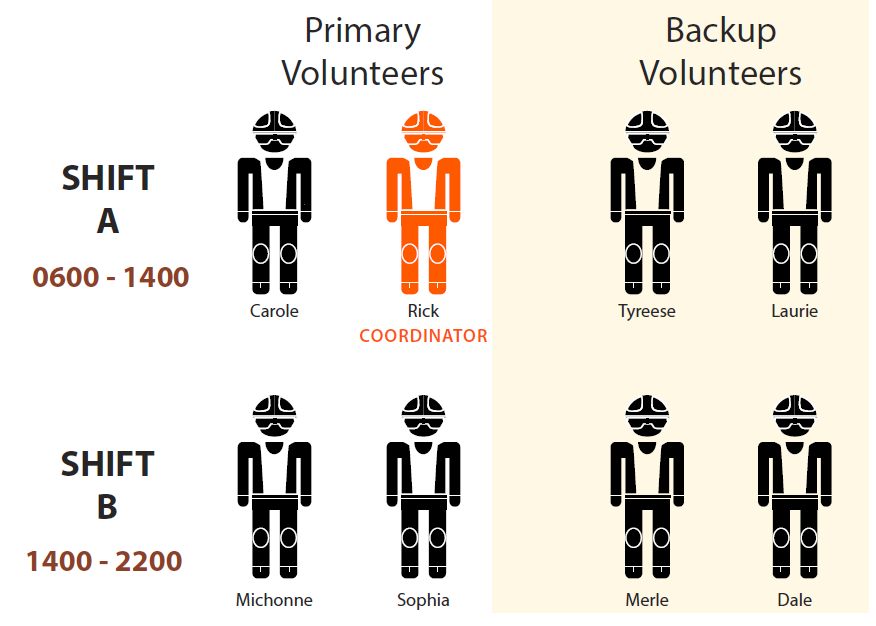
- A team is divided into two shifts (Shift A and Shift B) of four volunteers each. The intention is that in an emergency deployment, each shift will work for eight hours maximum and relay to the other shift at the end of eight hours. See Operational Periods and Shifts.
- Shift A and Shift B are further divided between two Primary Volunteers and two Backup Volunteers. If a Primary Volunteer is injured or for some other reason cannot deploy the BEECN, Backup Volunteers are available to fill in or take over deployment responsibilities. See Figure 1: BEECN Cohort Organization.

BEECN Team Coordinators
BEECN Coordinators have no field authority greater than other BEECN volunteers, but are responsible for organizing their cohort during blue sky periods. Responsibilities of the Team Coordinator include:
- Serving as PBEM’s point of contact for a BEECN’s team. PBEM will contact this individual to inform of BEECN drills or exercises, policy changes, or any other information relevant to the BEECN program. The Team Coordinator is responsible for relaying this information to team members.
- Serving as the point of contact for the owner/manager of the property hosting the cache. The Coordinator should contact the property owner/manager when BEECN exercises are scheduled.
- Working with team members to plan out shift and primary/backup volunteer designations for operations.
- Ensuring that team volunteers feel comfortable with using the cache equipment, can deploy the BEECN competently, and that all volunteers understand their role and responsibilities in the event of a BEECN deployment.
- Ensuring that the team has no fewer than eight members, and recruiting new members from the immediate neighborhood as needed.
- Providing PBEM with program feedback, recommendations, and resource requests as appropriate.
- Ensuring that the team responsibilities described in BEECN Teams are carried out, and the results of audits and exercises are relayed to PBEM.
BEECN Teams
Each BEECN Cohort has the following responsibilities:
- No less than monthly, do a sight check of the cache to ensure it is secure and has not been damaged or significantly tampered with, and that the tarp over it is still on tight (if the cache is outdoors). The check should always be logged in the BEECN Journaling System.
- No less than quarterly, inventory the contents of the cache through the BEECN Journaling System. Many caches include inventory forms to aid in the inventory process.
- No less than annually, participate in a BEECN activation exercise. PBEM will coordinate an exercise in the area of the BEECN once a year, but will coordinate more activation exercises at the request of a cohort as resources allow.
- In the event of a major earthquake, proceed with BEECN operations as described in Operations at BEECN Sites (which is also reflected in the volunteer position description for BEECN volunteers).
Fire Station Cohorts
A fire station volunteer is a specialized Amateur Radio Operator (ARO), or a non-licensed volunteer partnering with the ARO. Fire station volunteers also form a cohort of four (minimum) for each fire station. Each shift requires one primary and one backup ARO. Fire station Volunteers are responsible for relaying messages from BEECNs to the EOC during deployments and exercises and are fundamental to BEECN operations. Therefore, a BEECN cohort should know who the fire station volunteer is who will be relaying their messages. The responsibilities of fire station volunteers are described in their volunteer position descriptions and in the page Operations at Fire Stations.
BEECN Volunteers and Portland Neighborhood Emergency Teams
- BEECN volunteers and NETs operate independent of each other’s authority and are not under each other’s chain of command.
- PBEM encourages BEECN cohorts to meet with regularly with their local NETs, and to be familiar with their Earthquake Response Frameworks.
- One person may be both a NET and BEECN volunteer. NETs respond immediately following a major disaster, while BEECN volunteers operate 24 to 48 hours following an earthquake. Therefore, a volunteer can plausibly be part of both programs, and PBEM encourages volunteer participation in both.
Volunteer Support Functions and BEECN
All BEECN volunteers except AROs assigned to a fire station operate under VSF 14: Public Information. AROs operate under VSF 02: Communications.
Indemnification of BEECN Volunteers
BEECN and Fire Station volunteers are indemnified under the same policies as all PBEM volunteers. Please view the page on Volunteer Indemnification for more information.
Basic BEECN Training Links
The Basic Training for BEECN includes mention of several links. Here they are:
- The BEECN Guidelines: Main Page#SECTION 800: Basic Earthquake Emergency Communication Nodes (BEECN)
- The BEECN Volunteer Application: https://app.betterimpact.com/Application?OrganizationGuid=5c003f3a-8d04-4cdf-b8c0-41627fea7871&ApplicationFormNumber=1
- BEECN Volunteer Position Description: VSF 14.01.01: BEECN Volunteer
- Use PortlandMaps.com to find your nearest BEECN: https://www.portlandmaps.com/
- Email the BEECN program: beecn@portlandoregon.gov