Portland Bureau of Emergency Management
| General PBEM Volunteer Program Information |
| CPT Guidelines Creation and NETwiki Management |
| Portland Bureau of Emergency Management |
| General Volunteer Policies and Information |
| Volunteer Candidacy |
| Volunteer Standing and Badging |
| Volunteer Training Policies and Information |
| Volunteer Leadership |
| Volunteer Recognition Information |
| Supportive Information |
| Back to Main Guidelines ↱ |
The Portland Bureau of Emergency Management (PBEM) is the City of Portland's enterprise emergency management agency. It was established as a City bureau in 2004[1], and the Portland NET program was included as part of PBEM's portfolio.
- See also: PBEM's official webpage
Subpages
City Code 3.124.030 establishes that PBEM’s purpose is to “centralize leadership and coordination of emergency management.”[2] Former Mayor Sam Adams stated that the intent of PBEM was “to support timely and effective decision-making on issues of critical importance to the life, health, and welfare of Portlanders.”[3]
Over the years, PBEM has invested time and resources in three primary mission areas:
- Planning: Expand and maintain a complete suite of disaster mitigation, response, and recovery plans. This mission area also includes collaborating with other City bureaus on Continuity of Operations Plans (COOP), which describes how individual bureaus will get services to Portlanders back on line after a major disruption or disaster.
- Operations: Advance readiness of Portland's Emergency Operations Center (EOC). PBEM staff are responsible for maintaining the EOC and ensuring it is ready to activate at a moment's notice. This mission area also includes the Duty Officer program. PBEM Duty Officers are trained to activate the EOC for major emergencies and planned events. Duty Officers also monitor major emergency incidents and coordinate information sharing and operations between bureaus and Portland elected officials.
- Community Programming: Aims to inspire a culture of disaster resilience and preparedness. This mission area includes promoting a whole community approach to preparedness and integrating emergency management into broader community-oriented goals (such as disaster hubs). This mission area is managed by PBEM's Community Preparedness Team.
PBEM is led by a Director who reports to the Public Safety Service Area (PSSA) Deputy City Administrator. PBEM's mission is supported by a small in-house administrative team and administrators in the PSSA.
PBEM also shares office space with the Regional Disaster Policy Organization (RDPO). However, RDPO is considered a separate regional organization.
PBEM Community Preparedness Team (PBEM CPT)
- Some of the programs managed by PBEM's Community Preparedness Team.
-
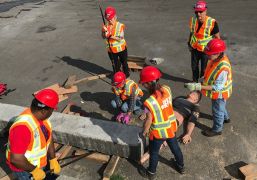 NET volunteers in a field exercise on May 31, 2019.
 -
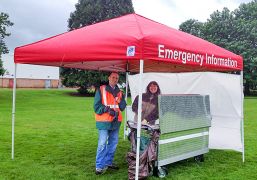 BEECN volunteers and a BEECN cache, May 22 2013.
 -
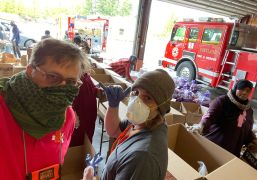 COAD partners packing and picking up supplies during COVID-19, April 24 2020.
 -
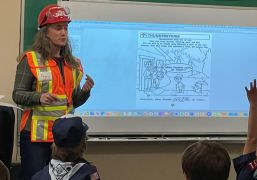 Angela Dorsey Kockler with the Speakers Bureau and a class of Cub Scouts on April 18 2022.
 -
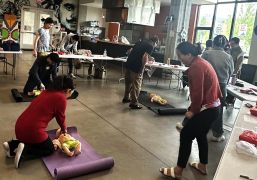 APANO holding a community CPR training on April 26 2025.
 -
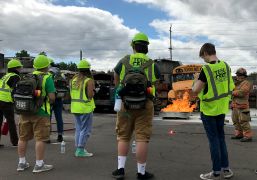 TeenCERT trainees about to put a fire out on June 1 2018.
.jpg)

.jpg)
.jpg)
.jpg)
.jpg)
PBEM's community programming and engagement is the purview of the Community Preparedness Team (CPT). CPT has several programs in their portfolio, as listed below:
Portland Neighborhood Emergency Teams (Portland NET)
- See also: NET official website, NET NETwiki page
Portland NET is the City of Portland's equivalent of a Community Emergency Response Team (CERT) program. In CPT's portfolio, it is also the largest program (with approximately 1,300 volunteers in July 2025) and the oldest (founded in 1994). Neighborhood Emergency Teams are Portland residents trained by PBEM and Portland Fire & Rescue to provide emergency disaster assistance within their own neighborhoods.
Basic Earthquake Emergency Communication Nodes (BEECN)
- See also: BEECN official website, BEECN NETwiki page
BEECN is an earthquake response communications program, powered by volunteers, and founded in 2012. A BEECN is a temporary radio communications site staffed by at least two volunteers after a major earthquake that takes down phone lines. BEECNs are places to report severe damage or injury or ask for emergency assistance. BEECN is a program of Portland NET.
Unidos NET
Unidos is Portland NET's Spanish language programming, and includes a team of Spanish-speaking NET volunteers. It is a program of Portland NET.
Community Organizations Active in Disaster (COAD)
- See also: COAD's official website, COAD's NETwiki page
Portland's COAD was formed in response to the COVID-19 pandemic in the Spring of 2020. COAD is a national model that brings together community organizations under four principles: Communication, Cooperation, Coordination and Collaboration. Each organization acts independently and retains full autonomy and authority in how they serve their communities.
Speakers Bureau
- See also: Speakers Bureau NETwiki page
The Speakers Bureau is a network of volunteers trained to deliver disaster preparedness presentations in their communities. Presentations are free of charge and available in multiple languages.
Community Trainings
- See also: Community Trainings NETwiki page
PBEM partners with local nonprofit organizations to offer disaster response training to the communities they serve directly. Training might include AED, CPR, First Aid, Stop the Bleed, fire extinguisher training, and more.
Business Engagement
- See also: Business Engagement NETwiki page
Business engagement is a new program in PBEM CPT. At this time, PBEM staff have not yet released curriculum related to this program.
Youth Programming
- See also: Youth Programming NETwiki page
Youth Programming is not offered by PBEM at this time. In the past, PBEM partnered with Portland Public Schools and other school districts to deliver disaster preparedness training and TeenCERT programming. Currently, Multnomah County is providing youth programming as their resources allow.
PBEM CPT Mission/VIsion/Values
TBA; strategic planning process began in early 2025 and is ongoing.
Notes and References
- ↑ However, in the FY 03-/04 adopted budget, City Council also transferred emergency management and Emergency Operations Center functions and funding from the Bureau of Fire & Rescue to the Portland Office of Emergency Management and approved the assignment of two positions from the Bureau of Fire & Rescue and two positions from the Police Bureau.
- ↑ Portland City Code Chapter 3.124: https://www.portland.gov/code/3/124
- ↑ May 17, 2010, Memo from Sam Adams, Mayor to LaVonne Griffin-Valade, City Auditor re: Response to Auditor’s Report #389: “Emergency Management: Coordination limited and essential functions incomplete”