Community Preparedness Team (CPT): Difference between revisions
No edit summary |
m HollisBlanchard moved page PBEM Community Preparedness Team (PBEM CPT) to Community Preparedness Team (CPT) |
||
| (17 intermediate revisions by 2 users not shown) | |||
| Line 1: | Line 1: | ||
{| class="wikitable mw-collapsible mw-collapsed" border="1" style="float:right; width:25%; margin-left:10px; border-collapse:collapse;" | |||
| style="background:#7C4DA1; color:white; text-align: center; border:2px solid white;"| '''<big>General PBEM Volunteer Program Information</big>''' | |||
|- | |||
| style="background:#f2e9fc; text-align:left; padding-left:20px; border:4px solid white;"| [[CPT Guidelines Creation and NETwiki Management]] | |||
<div class="toccolours mw-collapsible mw-collapsed"> | |||
<small>[[Purpose of Portland NETwiki]]</small> | |||
<small>[[Guidelines for NETwiki Content Creation and Editing]]</small> | |||
<small>Placeholder</small> | |||
<small>[[Wiki Code Cookbook]]</small> | |||
</div> | |||
|- | |||
| style="background:#f2e9fc; text-align:left; padding-left:20px; border:4px solid white;"| [[Portland Bureau of Emergency Management]] | |||
<div class="toccolours mw-collapsible mw-collapsed"> | |||
<small>[[PBEM Community Preparedness Team (PBEM CPT)]]</small> | |||
</div> | |||
|- | |||
| style="background:#f2e9fc; text-align:left; padding-left:20px; border:4px solid white;"| General Volunteer Policies and Information | |||
|- | |||
| style="background:#f2e9fc; text-align:left; padding-left:20px; border:4px solid white;"| Volunteer Candidacy | |||
|- | |||
| style="background:#f2e9fc; text-align:left; padding-left:20px; border:4px solid white;"| Volunteer Standing and Badging | |||
|- | |||
| style="background:#f2e9fc; text-align:left; padding-left:20px; border:4px solid white;"| Volunteer Training Policies and Information | |||
|- | |||
| style="background:#f2e9fc; text-align:left; padding-left:20px; border:4px solid white;"| Volunteer Leadership | |||
|- | |||
| style="background:#f2e9fc; text-align:left; padding-left:20px; border:4px solid white;"| Volunteer Recognition Information | |||
|- | |||
| style="background:#f2e9fc; text-align:left; padding-left:20px; border:4px solid white;"| Supportive Information | |||
|- | |||
| style="background:gainsboro; text-align: center; border:2px solid white;"|'''<big>[[Main_Page|Back to Main Guidelines ↱]]</big>''' | |||
|} | |||
<br /> | |||
__TOC__ | |||
<br /> | |||
== PBEM CPT Programs == | == PBEM CPT Programs == | ||
PBEM's community programming and engagement is the purview of the Community Preparedness Team (CPT). CPT has several programs in their portfolio, as listed below:<gallery mode="packed-overlay" widths="200" caption="''Some of the programs managed by PBEM's Community Preparedness Team.''"> | PBEM's community programming and engagement is the purview of the Community Preparedness Team (CPT). CPT has several programs in their portfolio, as listed below:<gallery mode="packed-overlay" widths="200" caption="''Some of the programs managed by PBEM's Community Preparedness Team.''"> | ||
| Line 24: | Line 64: | ||
==== Speakers Bureau ==== | ==== Speakers Bureau ==== | ||
:''See also: Speakers Bureau NETwiki page'' | :''See also: [[Speakers Bureau|Speakers Bureau NETwiki page]]'' | ||
The Speakers Bureau is a network of volunteers trained to deliver disaster preparedness presentations in their communities. Presentations are free of charge and available in multiple languages. | The Speakers Bureau is a network of volunteers trained to deliver disaster preparedness presentations in their communities. Presentations are free of charge and available in multiple languages. | ||
| Line 38: | Line 78: | ||
:''See also: Youth Programming NETwiki page'' | :''See also: Youth Programming NETwiki page'' | ||
Youth Programming is not offered by PBEM at this time. In the past, PBEM partnered with Portland Public Schools and other school districts to deliver disaster preparedness training and TeenCERT programming. Currently, Multnomah County is providing youth programming as their resources allow. | Youth Programming is not offered by PBEM at this time. In the past, PBEM partnered with Portland Public Schools and other school districts to deliver disaster preparedness training and TeenCERT programming. Currently, Multnomah County is providing youth programming as their resources allow. | ||
<br> | <br> | ||
== PBEM CPT | == PBEM CPT Strategic Planning == | ||
TBA; strategic planning process began in early 2025 and is ongoing. | TBA; strategic planning process began in early 2025 and is ongoing. | ||
<br> | |||
=== PBEM's Approach to Community Resilience === | |||
[[File:Community Resilience Trends.jpg|alt=Screenshot (taken 2023.10.05) from Google Trends charting search engine interest in the term "Community Resilience", with a the most significant spike in July to September 2005.|thumb|400x400px|'''''Diagram 1:''''' ''Screenshot (taken 2023.10.05) from Google Trends charting search engine interest in the term "Community Resilience", with a the most significant spike in July to September 2005. Click to enlarge.'']] | |||
'''Community resilience is a shared, community-based practice building social connections, collective strengths, and skills key to resisting/absorbing/recovering from a widespread disaster, as well as local and regional emergencies.''' | |||
Participants in PBEM community programs will notice this view of resilience in all our activities and coaching. We build it into the Neighborhood Emergency Team (NET) program, Community Resilience Workbook, and Community Organizations Active in Disaster (COAD). But, PBEM's CRT definition is not the only definition of community resilience, and that matters. | |||
Americans have shown growing interest in "community resilience" since [[wikipedia:Hurricane_Katrina|Hurricane Katrina]] struck in August 2005 (see diagram 1). In a feedback loop of interest generating ideas, many academics, civil servants, and leaders see a link between resilience and a reduction of harmful outcomes from disasters, without clarity on what “community resilience” should ''mean''. As a result, different definitions of community resilience exist. Each reflect, and are freighted by, the views of their authors. | |||
PBEM's definition suits us, borrowing from many others, while possibly not passing muster among hard-nosed social scientists.<ref>For context, the most recognized definition of resilience comes from the [https://www.undrr.org/terminology/resilience United Nation International Strategy for Disaster Reduction (UNISDR)]: ''“the ability of a system, community or society exposed to hazards to resist, absorb, accommodate to and recover from the effects of a hazard in a timely and efficient manner, including through the preservation and restoration of its essential basic structures and functions”.''</ref> Fortunately, this Wiki was not written for them. Volunteers should simply know that many approaches to community resilience exist. PBEM CRT's definition of community resilience ''specifically'' serves an ''orientation to disaster preparedness and response''. Our program addresses the periods before, during, and after a disaster. | |||
The big question comes in whether other community resilience approaches can fit with PBEM’s. When PBEM volunteers raise a momentum of activity around their work, they may meet neighbors responding to that momentum by placing their own legitimate community resilience interests on the agenda. That might include serving the homeless, or economic development, or crime prevention, or neighborhood preservation, among other possibilities. Those considerations are addressed as part of the [[Community Resilience Districts|Community Resilience District (CRD)]] concept, and not discussed in this article. | |||
<br/> | |||
== CPT Programming Budgets == | |||
:See also: [https://app.smartsheet.com/b/publish?EQBCT=339d2fe9fca64aa88a59397af11c079f CPT Budget Dashboard] | |||
'''The PBEM CPT program budget is a complicated creature.''' | |||
As you walk through it, you'll see it relies on different significant funding sources (grants and city general fund) and is sliced into smaller "program-lets" and projects. There are seven program "buckets" in NET: '''''Program Operations, Basic NET, Advanced Training, Radio, Community Organizing, Youth Programming,''''' and '''''Program Development.''''' We'll break down each of them. This budget does not include personnel costs (salaries and benefits). | |||
Spending is often cross referenced between programs/projects to accurately evaluate outcomes and deliverables. On top of all that, NET spends its budget over many small transactions...380 on an average fiscal year. | |||
'''Why a NET budget dashboard?''' | |||
* Simplify monitoring program budget for internal City of Portland staff. | |||
* Create a clear guide for comparing program outcomes to spending. | |||
* Transparency for NET volunteers. | |||
* General educational purposes. | |||
<br/> | |||
== CPT Programming and Other Agencies == | |||
PBEM staff are often asked how CPT programming interfaces and collaborates with other government jurisdictions. | |||
<br/> | |||
== Notes and References == | |||
<references /> | |||
Latest revision as of 16:39, 19 August 2025
| General PBEM Volunteer Program Information |
| CPT Guidelines Creation and NETwiki Management |
| Portland Bureau of Emergency Management |
| General Volunteer Policies and Information |
| Volunteer Candidacy |
| Volunteer Standing and Badging |
| Volunteer Training Policies and Information |
| Volunteer Leadership |
| Volunteer Recognition Information |
| Supportive Information |
| Back to Main Guidelines ↱ |
PBEM CPT Programs
PBEM's community programming and engagement is the purview of the Community Preparedness Team (CPT). CPT has several programs in their portfolio, as listed below:
- Some of the programs managed by PBEM's Community Preparedness Team.
-
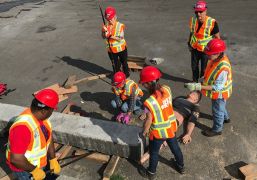 NET volunteers in a field exercise on May 31, 2019.
 -
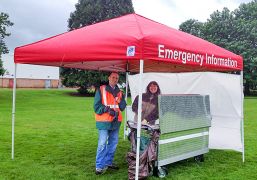 BEECN volunteers and a BEECN cache, May 22 2013.
 -
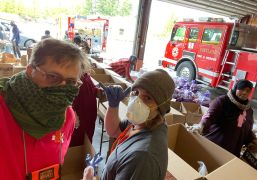 COAD partners packing and picking up supplies during COVID-19, April 24 2020.
 -
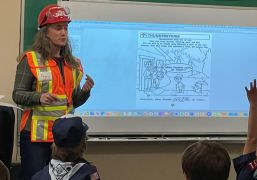 Angela Dorsey Kockler with the Speakers Bureau and a class of Cub Scouts on April 18 2022.
 -
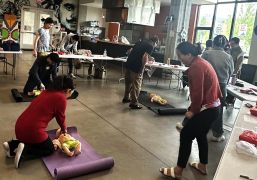 APANO holding a community CPR training on April 26 2025.
 -
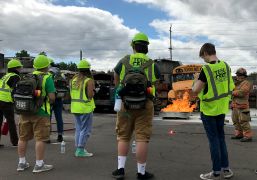 TeenCERT trainees about to put a fire out on June 1 2018.
.jpg)

.jpg)
.jpg)
.jpg)
.jpg)
Portland Neighborhood Emergency Teams (Portland NET)
- See also: NET official website, NET NETwiki page
Portland NET is the City of Portland's equivalent of a Community Emergency Response Team (CERT) program. In CPT's portfolio, it is also the largest program (with approximately 1,300 volunteers in July 2025) and the oldest (founded in 1994). Neighborhood Emergency Teams are Portland residents trained by PBEM and Portland Fire & Rescue to provide emergency disaster assistance within their own neighborhoods.
Basic Earthquake Emergency Communication Nodes (BEECN)
- See also: BEECN official website, BEECN NETwiki page
BEECN is an earthquake response communications program, powered by volunteers, and founded in 2012. A BEECN is a temporary radio communications site staffed by at least two volunteers after a major earthquake that takes down phone lines. BEECNs are places to report severe damage or injury or ask for emergency assistance. BEECN is a program of Portland NET.
Unidos NET
Unidos is Portland NET's Spanish language programming, and includes a team of Spanish-speaking NET volunteers. It is a program of Portland NET.
Community Organizations Active in Disaster (COAD)
- See also: COAD's official website, COAD's NETwiki page
Portland's COAD was formed in response to the COVID-19 pandemic in the Spring of 2020. COAD is a national model that brings together community organizations under four principles: Communication, Cooperation, Coordination and Collaboration. Each organization acts independently and retains full autonomy and authority in how they serve their communities.
Speakers Bureau
- See also: Speakers Bureau NETwiki page
The Speakers Bureau is a network of volunteers trained to deliver disaster preparedness presentations in their communities. Presentations are free of charge and available in multiple languages.
Community Trainings
- See also: Community Trainings NETwiki page
PBEM partners with local nonprofit organizations to offer disaster response training to the communities they serve directly. Training might include AED, CPR, First Aid, Stop the Bleed, fire extinguisher training, and more.
Business Engagement
- See also: Business Engagement NETwiki page
Business engagement is a new program in PBEM CPT. At this time, PBEM staff have not yet released curriculum related to this program.
Youth Programming
- See also: Youth Programming NETwiki page
Youth Programming is not offered by PBEM at this time. In the past, PBEM partnered with Portland Public Schools and other school districts to deliver disaster preparedness training and TeenCERT programming. Currently, Multnomah County is providing youth programming as their resources allow.
PBEM CPT Strategic Planning
TBA; strategic planning process began in early 2025 and is ongoing.
PBEM's Approach to Community Resilience

Community resilience is a shared, community-based practice building social connections, collective strengths, and skills key to resisting/absorbing/recovering from a widespread disaster, as well as local and regional emergencies.
Participants in PBEM community programs will notice this view of resilience in all our activities and coaching. We build it into the Neighborhood Emergency Team (NET) program, Community Resilience Workbook, and Community Organizations Active in Disaster (COAD). But, PBEM's CRT definition is not the only definition of community resilience, and that matters.
Americans have shown growing interest in "community resilience" since Hurricane Katrina struck in August 2005 (see diagram 1). In a feedback loop of interest generating ideas, many academics, civil servants, and leaders see a link between resilience and a reduction of harmful outcomes from disasters, without clarity on what “community resilience” should mean. As a result, different definitions of community resilience exist. Each reflect, and are freighted by, the views of their authors.
PBEM's definition suits us, borrowing from many others, while possibly not passing muster among hard-nosed social scientists.[1] Fortunately, this Wiki was not written for them. Volunteers should simply know that many approaches to community resilience exist. PBEM CRT's definition of community resilience specifically serves an orientation to disaster preparedness and response. Our program addresses the periods before, during, and after a disaster.
The big question comes in whether other community resilience approaches can fit with PBEM’s. When PBEM volunteers raise a momentum of activity around their work, they may meet neighbors responding to that momentum by placing their own legitimate community resilience interests on the agenda. That might include serving the homeless, or economic development, or crime prevention, or neighborhood preservation, among other possibilities. Those considerations are addressed as part of the Community Resilience District (CRD) concept, and not discussed in this article.
CPT Programming Budgets
- See also: CPT Budget Dashboard
The PBEM CPT program budget is a complicated creature.
As you walk through it, you'll see it relies on different significant funding sources (grants and city general fund) and is sliced into smaller "program-lets" and projects. There are seven program "buckets" in NET: Program Operations, Basic NET, Advanced Training, Radio, Community Organizing, Youth Programming, and Program Development. We'll break down each of them. This budget does not include personnel costs (salaries and benefits).
Spending is often cross referenced between programs/projects to accurately evaluate outcomes and deliverables. On top of all that, NET spends its budget over many small transactions...380 on an average fiscal year. Why a NET budget dashboard?
- Simplify monitoring program budget for internal City of Portland staff.
- Create a clear guide for comparing program outcomes to spending.
- Transparency for NET volunteers.
- General educational purposes.
CPT Programming and Other Agencies
PBEM staff are often asked how CPT programming interfaces and collaborates with other government jurisdictions.
Notes and References
- ↑ For context, the most recognized definition of resilience comes from the United Nation International Strategy for Disaster Reduction (UNISDR): “the ability of a system, community or society exposed to hazards to resist, absorb, accommodate to and recover from the effects of a hazard in a timely and efficient manner, including through the preservation and restoration of its essential basic structures and functions”.